Aerosol Studio Ventilation: Exact CFM for 99% Fume Clearance
Advertisements
Aerosol studio ventilation should be designed around contaminant capture, airflow direction, chemical hazards and applicable safety requirements rather than one universal CFM or air-change target.
Spray paints can release solvent vapors, overspray particles and other hazardous substances, making source control and mechanical exhaust critical during indoor spray work.
A safe system therefore requires more than calculating room volume, because the same CFM can perform very differently depending on booth design, duct resistance and air distribution.
Why Aerosol Spray Ventilation Requires Special Attention
Spray application produces airborne droplets and vapors that can spread beyond the immediate painting area if they are not captured effectively.
Some coatings can contain organic solvents, metals or other substances capable of causing respiratory, neurological, skin or eye effects depending on exposure.
Ventilation should therefore control contaminants before they move through the worker's breathing zone or accumulate elsewhere in the building.
Paint Overspray and Solvent Vapor Are Different Hazards
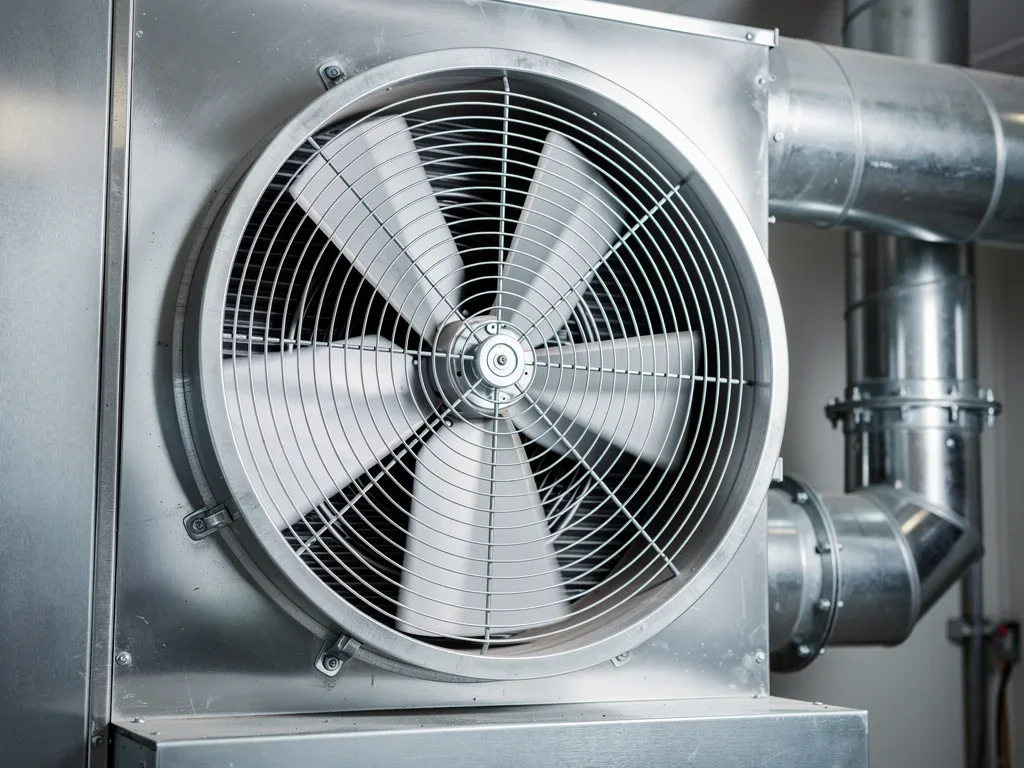
Overspray consists largely of airborne coating droplets or particles, while solvent vapor comes from volatile components evaporating from the paint or coating.
A system effective at collecting particulate overspray does not automatically remove every hazardous vapor to an acceptable concentration.
Ventilation design must therefore consider both the physical aerosol and the chemical composition listed in the product's safety data sheet.
There Is No Universal CFM for Every Aerosol Studio
CFM measures how many cubic feet of air a ventilation system moves each minute, but airflow quantity alone does not determine worker exposure.
Room size, source location, exhaust placement, duct pressure losses and makeup-air patterns all determine whether contaminants are actually captured effectively.
Two studios with identical volumes can therefore require very different ventilation systems even when artists use superficially similar aerosol products.
Why a Simple Room-Volume Formula Is Not Enough
The familiar formula using room volume and air changes per hour describes overall air replacement rather than direct capture of contaminants at the spray source.
Dilution ventilation can allow contaminants to pass through the breathing zone before they eventually reach the exhaust.
OSHA guidance consequently emphasizes placing exhaust as close as practical to emission sources when dilution ventilation is used.
OSHA Uses Air Velocity for Spray Booths
For conventional dry-type spray booths, OSHA requires airflow designed to move overspray and vapors toward the exhaust rather than allowing uncontrolled dispersion.
The applicable standard generally requires an average air velocity of at least 100 linear feet per minute across the open booth face or cross section during spraying.
Electrostatic spraying may use lower minimum velocities under specified conditions, depending on the finishing material and fire characteristics.
Velocity and CFM Are Related but Not Identical
CFM can be derived from air velocity when the effective cross-sectional area of the booth opening is known.
A larger booth opening needs more total airflow than a smaller one to maintain the same face velocity.
This is why specifying “800 CFM” without identifying booth dimensions can be misleading even when the fan rating itself appears substantial.
How CFM Relates to Booth Opening Area
The basic airflow relationship is CFM equals average air velocity in feet per minute multiplied by the effective open area in square feet.
For example, maintaining a given face velocity over a large opening requires proportionally greater airflow than maintaining that velocity over a compact enclosure.
Real installations also need allowances for filters, duct friction and other resistance that reduce the airflow a fan delivers after installation.
Fan Nameplate CFM Is Not the Final System Airflow
Fans are rated according to operating conditions, and their delivered airflow normally changes as static pressure increases.
Filters, long ducts, elbows, dampers and discharge arrangements can all add resistance to the ventilation system.
Fan selection should therefore use the complete system pressure requirement and the manufacturer's performance curve instead of relying solely on free-air CFM.
The 99% Clearance Claim Needs Context
Removing 99% of a contaminant from a room is sometimes discussed using exponential decay equations based on repeated air replacement.
Under ideal perfect-mixing assumptions, concentration decreases predictably as clean air replaces contaminated air after the contaminant source has stopped.
Real rooms rarely achieve perfect mixing, making theoretical clearance times potentially much shorter than actual clearance times.
Perfect Mixing Is an Important Assumption
An archived OSHA clearance table specifically notes that contaminant-removal calculations assume perfect mixing within the room.
The same document warns that real mixing can be substantially poorer and may require a mixing factor that lengthens the calculated clearance time.
That means a theoretical 99% purge calculation should not be interpreted as proof that every point in a studio is safe after the calculated time.
Clearance Calculations Apply After Emissions Stop
A purge-time calculation describes how concentration might decline after the contaminant source is no longer adding material to the air.
During active spraying, the system must simultaneously remove material while new contaminant is continuously being generated.
This is why designing an active spray area around a simple post-use clearance percentage can underestimate actual exposure during painting.
Active Spraying Requires Continuous Mechanical Ventilation
OSHA requires mechanical ventilation to remain operating while spraying is occurring and for sufficient time afterward to exhaust vapors from drying materials.
This requirement recognizes that emissions continue after the spray trigger is released because coatings and residues can keep releasing vapor.
A timer based solely on room air changes therefore cannot replace appropriate spray-area ventilation.
Local Exhaust Ventilation Is Usually More Effective
Local exhaust ventilation captures contaminants near their point of generation before they spread through the general workspace.
A spray booth is one example because it confines the operation and directs contaminated air toward an engineered exhaust system.
This approach generally provides better source control than attempting to clean the entire studio after fumes have dispersed.
Capture Before Dilution
OSHA describes local exhaust systems as equipment intended to capture emitted contaminants at or near their source.
A typical system includes a hood or enclosure, ducts, an air cleaner where appropriate, a fan and a discharge stack.
Proper design keeps the contaminant from first entering the worker's breathing zone and then relying on room dilution afterward.
Airflow Direction Matters as Much as Airflow Quantity
Effective systems move clean air from behind or around the worker toward the contaminated work area and then into the exhaust.
Poorly placed supply air can push overspray back toward the artist or create turbulent recirculation inside the workspace.
The goal is a predictable airflow path that moves contamination away from occupied breathing zones.
Avoid Dead Zones and Recirculation
Corners, large objects and poorly positioned intake openings can create stagnant zones where vapors and particles remain longer than expected.
OSHA specifically requires spray-room air intakes to be located to minimize dead-air pockets while allowing exhaust fans to operate effectively.
Smoke visualization or professional airflow testing can help identify patterns that are difficult to infer from fan capacity alone.
Makeup Air Is Essential
Every cubic foot of air exhausted from a studio must ultimately be replaced by air entering from somewhere else.
Without adequate makeup air, strong negative pressure can reduce exhaust performance and pull uncontrolled air through doors, cracks or neighboring rooms.
A well-designed system intentionally supplies replacement air without directing contamination back toward workers or other building occupants.
Makeup Air Should Not Short-Circuit the Exhaust
Supply air entering immediately next to the exhaust can travel directly out without effectively sweeping the spray area.
Air should instead move across the occupied work zone in a deliberate path that carries contaminants toward capture points.
OSHA spray-finishing guidance specifically calls for clean fresh makeup air to replace air exhausted from spray booths.
Exhaust Air Should Be Discharged Safely
Spray-contaminated air should not simply be moved from the studio into another occupied room or neighboring indoor area.
OSHA requires spray-operation exhaust to be discharged so it does not contaminate makeup-air openings or create hazardous conditions elsewhere.
For regulated spray-finishing operations, exhausted air generally should not be recirculated back into the workplace.
Outdoor Discharge Location Matters
An exterior exhaust positioned too close to windows, doors or air intakes can allow contamination to re-enter the building.
Fire and building codes may also establish separation requirements from combustible construction, property lines and other features.
Discharge design should therefore be coordinated with applicable codes rather than selected only for convenience.
Filtration for Overspray Is Not the Same as VOC Control
Particulate filters can capture paint droplets and solid overspray before they coat ducts, fans or the outdoor discharge area.
Gas-phase contaminants such as solvent vapors behave differently and can pass through filters designed primarily for particles.
A filter system should therefore be selected for the actual contaminants identified in the spray products being used.
Activated Carbon Has Limitations
Activated carbon can adsorb certain organic vapors, but capacity depends on chemical type, concentration, humidity, airflow and the amount of carbon available.
A small carbon pad should not automatically be assumed to make recirculated spray-paint air safe for indoor breathing.
For regulated spray operations, outdoor exhaust and appropriate engineering controls remain central parts of the ventilation approach.
Do Not Recirculate Contaminated Spray Air Casually
Recirculating filtered air may appear attractive because conditioned indoor air is expensive to replace, especially during very hot or cold weather.
However, incomplete removal of solvent vapors can allow contaminants to accumulate gradually inside the building.
OSHA specifically states that air exhausted from spray operations shall not be recirculated under the spray-finishing standard.
Energy Savings Must Not Override Exposure Control
Variable-speed fans and smart controls can reduce energy use when properly engineered around actual process requirements.
They should not reduce airflow below the level required to control overspray, vapors and fire hazards during active spraying.
Any automated strategy should fail safely and preserve required ventilation whenever spraying equipment is operating.
Fan Construction Can Be a Fire-Safety Issue
Many aerosol paints contain flammable solvents, meaning the exhaust system must address ignition hazards as well as respiratory exposure.
OSHA requires spray-finishing fans and related equipment to be designed so rotating components do not create dangerous friction sparks.
Electrical equipment in classified spray areas may also need to meet specific hazardous-location requirements.
A Household Box Fan Is Not a Spray Booth
A consumer fan was not necessarily designed for flammable vapor environments, overspray loading or the static pressure of filters and ductwork.
Using unsuitable electrical equipment around ignitable vapors can introduce an additional hazard even if the fan appears to move significant air.
Ventilation equipment should be selected according to the spray process and applicable electrical and fire-safety requirements.
Spray Booth Construction Has Specific Requirements
For occupational spray-finishing applications, OSHA specifies construction requirements intended to limit fire and residue hazards within spray areas.
Spray booths are generally constructed from steel, concrete, masonry or other approved noncombustible materials under applicable provisions.
Interior surfaces should also minimize residue accumulation and facilitate safe cleaning and maintenance.
Ducts Also Need Safe Construction
Exhaust ductwork can accumulate coating residue over time and therefore must be designed with fire safety and cleaning access in mind.
OSHA provisions include requirements affecting duct materials, fan arrangement and access for cleaning where necessary.
Improvised flexible household ducting may not satisfy the requirements applicable to a professional spray-finishing installation.
Respiratory Protection May Still Be Necessary
Effective ventilation can substantially reduce exposure but does not guarantee that hazardous substances disappear completely from the worker's breathing zone.
NIOSH specifically recommends appropriate respiratory protection in addition to properly designed spray equipment and ventilated booths for paint-spray exposures.
Respirator selection must match the contaminant, concentration and conditions rather than relying on a generic dust mask.
Respirators Require Proper Selection and Fit
Chemical-cartridge respirators have concentration limits, service-life restrictions and applications for which they are not appropriate.
NIOSH notes that chemical cartridges are not for oxygen-deficient or immediately dangerous to life or health atmospheres.
Occupational use can also require medical evaluation, fit testing, training and a respiratory-protection program under applicable OSHA requirements.
The Safety Data Sheet Is an Important Starting Point
Aerosol products can contain very different solvents, pigments, propellants and other ingredients even when they perform similar artistic functions.
The safety data sheet identifies hazard classifications, exposure information, protective measures and recommendations for handling and ventilation.
Designing only around the generic phrase “spray paint” can miss hazards associated with a particular formulation.
Different Chemicals Have Different Exposure Limits
Occupational exposure standards are generally expressed as contaminant concentrations rather than one universal ventilation rate.
OSHA permissible exposure limits vary by substance, and mixed exposures can require additional evaluation when several contaminants are present simultaneously.
This is another reason ventilation requirements cannot safely be determined from room dimensions alone.
Dilution Ventilation Requires an Emission Estimate
When dilution ventilation is appropriate, OSHA's technical guidance calculates airflow using the rate at which the contaminant enters the air and an acceptable concentration.
The method also includes a mixing factor because actual rooms do not distribute contaminants perfectly or uniformly.
This is considerably more specific than selecting a fixed number of air changes per hour for every spray process.
ACH Is a Result, Not Always the Design Criterion
Air changes per hour describe how the airflow compares with the room volume and can be useful for understanding overall ventilation intensity.
However, the same ACH can produce good or poor exposure control depending on where clean air enters and contaminated air leaves.
For spray finishing, capture velocity and booth airflow can be more directly relevant than a room-wide ACH target.
Why 60 ACH Should Not Be Used as a Universal Rule
The original proposal of using 60 air changes per hour as a general minimum does not correspond to a universal OSHA requirement for aerosol-art studios.
Some specialized processes may involve very high ventilation rates, while properly designed enclosed booths are evaluated using airflow and contaminant-control criteria.
A safe design should therefore begin with the actual spray operation rather than choosing 60 ACH and calculating a fan from that assumption.
High ACH Does Not Guarantee Good Capture
A room can theoretically exchange air very frequently while still allowing a contaminated plume to travel directly across the artist's face.
Conversely, effective local capture can control exposure efficiently without relying on extreme ventilation throughout the entire building.
Airflow geometry and source capture must therefore accompany any discussion of total ventilation volume.
Air Monitoring Can Verify Performance
Measurement can help determine whether an installed ventilation system is controlling contaminants as intended under actual working conditions.
Useful evaluations can include airflow velocity, static pressure and exposure sampling selected for the specific substances used in the studio.
This type of verification is stronger than assuming the system works because its fan matches a theoretical CFM calculation.
Consumer VOC Sensors Have Limits
Low-cost indoor air monitors can provide useful trend information but may not identify individual solvents or measure them accurately enough for regulatory exposure assessment.
Many consumer devices report a broad total-VOC estimate rather than substance-specific concentrations comparable with occupational exposure limits.
Professional industrial-hygiene sampling may therefore be necessary when exposure compliance or hazardous chemical concentrations must be confirmed.
Particulate Monitoring Does Not Measure Every Vapor
A PM2.5 monitor detects airborne particles within specific size ranges but does not measure solvent molecules present as gases.
A studio can therefore show a relatively low particle reading while still containing an important concentration of organic vapor.
Monitoring strategies should match the contaminants identified in the coating rather than relying on one sensor for every hazard.
Use Monitoring to Support Engineering Controls
Sensors should verify that controls are working rather than substitute for a properly designed exhaust system.
An alarm only warns that conditions have deteriorated after contamination is already present in the space.
Source capture, safe exhaust and adequate makeup air remain the primary engineering controls for routine spray work.
Downdraft Booths Can Reduce Overspray Exposure
NIOSH has evaluated spray-painting environments and recommends properly operated downdraft booths for reducing paint overspray exposure compared with some alternative booth configurations.
Downdraft airflow moves air vertically through the work area toward floor-level capture rather than pulling the entire plume horizontally past the worker.
Actual booth selection still depends on the object size, process, building and applicable safety requirements.
Booth Design Should Fit the Artistic Process
Aerosol mural work, small-object spraying and large-panel finishing create very different source geometries and working positions.
A booth designed for one activity may provide poor capture when artists spray outside its intended zone or block the designed airflow path.
The ventilation system should therefore be designed around the actual objects, spray direction and artist position expected during use.
Overspray Filters Need Maintenance
Dry filters capture coating particles and gradually load with material, which increases resistance and reduces airflow through the system.
A fan that initially meets the required velocity may therefore fall below its design condition as filters become dirty.
OSHA requires provisions to indicate or ensure that required airflow is maintained in applicable dry spray booths.
Pressure Drop Can Indicate Filter Loading
Many professional systems use pressure gauges or other indicators to show when filter resistance has increased beyond an acceptable range.
Replacement schedules should follow the booth or filter manufacturer's criteria rather than waiting until airflow visibly appears weak.
Loaded filters can reduce exposure control and may also increase combustible residue accumulation inside the system.
Ventilation Must Continue During Drying Where Needed
Freshly coated surfaces can continue releasing volatile compounds after spraying ends because solvents remain in the wet film and evaporate during drying.
OSHA requires adequate ventilation for drying areas where explosive vapor accumulation could otherwise occur.
Shutting the exhaust off immediately after spraying can therefore defeat part of the protection provided during active application.
Post-Spray Run Time Should Be Process-Specific
The necessary ventilation period depends on coating formulation, quantity applied, drying behavior, room airflow and other process conditions.
A fixed five- or ten-minute timer cannot be assumed adequate for every material or project.
Equipment instructions, monitoring and professional evaluation provide a more defensible basis for determining safe post-spray operation.
Studio Size Alone Does Not Determine Exposure
A small spray source inside a large room may still create very high exposure near the artist before dilution reduces the average room concentration.
Conversely, a well-contained operation can prevent much of the contaminant from entering the larger room in the first place.
Worker position relative to the spray plume is therefore often more important than total room volume.
Keep the Artist Out of the Contaminated Air Path
Fresh air should reach the worker before traveling across the spray source whenever the process and booth design allow it.
The exhaust should then pull contaminated air away from the worker rather than drawing overspray through the breathing zone.
This fundamental principle applies regardless of whether the final system uses crossdraft, semi-downdraft or downdraft ventilation.
Regulations Depend on the Type of Studio
An employee workplace, commercial spray operation, educational art facility and private hobby space can fall under different regulatory and building-code requirements.
Fire codes, electrical rules, environmental requirements and local permits can apply in addition to occupational exposure regulations.
A professional designer should therefore verify which rules govern the specific location before equipment is purchased or ductwork installed.
OSHA Standards Are Occupational Requirements
OSHA standards primarily govern workplace safety and do not function as a complete residential building specification for every private studio.
Local fire and building departments can impose additional requirements concerning spray rooms, hazardous locations and exterior exhaust.
Meeting one airflow number does not establish compliance with every rule relevant to a commercial aerosol workspace.
A Professional Ventilation Assessment Is Often Appropriate
Spray systems combine occupational exposure, fire safety, electrical classification, duct design and chemical compatibility in one installation.
An industrial hygienist or qualified mechanical ventilation professional can evaluate emission sources, worker position and actual exposure conditions.
For commercial or high-volume aerosol use, professional design is safer than selecting a fan solely from online CFM calculators.
Performance Should Be Commissioned After Installation
A completed system should be tested to confirm face velocity, airflow direction and fan performance under normal filter and duct conditions.
Testing can reveal installation problems such as restricted ducts, inadequate makeup air or unexpected turbulence that design calculations missed.
Periodic rechecking helps ensure system performance has not deteriorated as filters load and components age.
Training Is Part of the Control System
Even a well-designed booth performs poorly when artists spray outside the capture zone, block air openings or operate equipment with ventilation disabled.
Users need to understand how airflow should move, when exhaust must operate and how to recognize warning signs of reduced performance.
Training should also cover product hazards, cleanup, waste handling and emergency procedures for ventilation failure.
PPE Does Not Replace Ventilation
Respiratory and skin protection can add important layers of protection, but personal protective equipment should not substitute for feasible engineering controls.
NIOSH recommends combining ventilated spray booths with appropriate respiratory protection when paint-spray hazards remain.
Safe studio practice uses multiple layers of control rather than relying exclusively on a respirator or a large exhaust fan.
Aerosol Studio Ventilation at a Glance
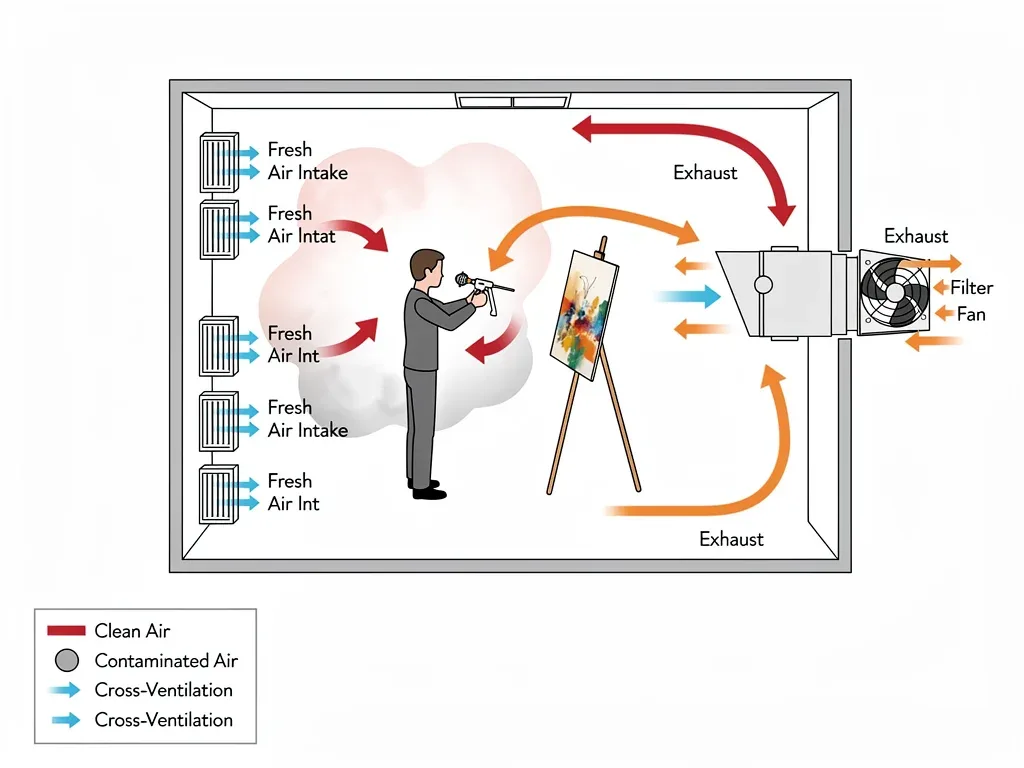
Safe aerosol studio ventilation depends on capturing contaminants effectively, maintaining required airflow and safely exhausting hazardous vapors and overspray.
A single ACH or CFM value cannot guarantee 99% contaminant removal because source strength, airflow distribution and chemical hazards vary between studios.
The table below separates useful ventilation concepts from assumptions that should not be treated as universal design rules.
Design Around Exposure Control
Room volume remains useful information, but it should be only one input in a broader engineering analysis.
Spray-booth velocity, contaminant generation, duct resistance, makeup air and worker position all influence the final design.
Verification after installation is essential because calculations alone cannot confirm that hazardous exposure is adequately controlled.
Key Aspect | Practical Guidance |
|---|---|
Universal 60 ACH Rule | No universal OSHA requirement establishes 60 ACH as the minimum for every aerosol studio. |
Conventional Spray Booth Velocity | OSHA generally requires at least 100 fpm average air velocity for applicable conventional dry spray booths. |
CFM | Depends on required velocity, effective opening area and system pressure losses. |
99% Clearance | Theoretical purge calculations depend on mixing assumptions and apply after contaminant generation stops. |
Preferred Control | Capture contaminants at or near the spray source using properly designed local exhaust. |
Makeup Air | Must replace exhausted air without creating dead zones or returning contamination to the worker. |
Respiratory Protection | May still be needed because ventilation does not necessarily eliminate exposure completely. |
Frequently Asked Questions About Aerosol Studio Ventilation
Is 60 ACH required for an aerosol studio?
No. OSHA does not establish 60 ACH as a universal requirement for all aerosol studios; applicable spray-finishing rules focus heavily on airflow velocity and contaminant control.
What airflow does OSHA require for a conventional spray booth?
Applicable conventional dry-type booths generally require at least 100 feet per minute of average air velocity across the open face or booth cross section.
Can I calculate CFM from room volume alone?
No. Room volume can support dilution calculations, but safe spray ventilation also depends on emissions, capture geometry, face velocity, duct losses and makeup air.
Can ventilation guarantee 99% fume removal?
Not through one universal CFM value. Theoretical 99% purge calculations assume specific mixing conditions and do not directly establish safe exposure during active spraying.
Should spray air be recirculated indoors after filtration?
For spray-finishing operations covered by OSHA's standard, exhaust air from spray operations is not to be recirculated into the workplace.
Do particulate filters remove VOCs?
Not necessarily. Filters designed for overspray particles do not automatically remove solvent vapors, which require different control considerations.
Is activated carbon enough to make spray-paint air safe?
Not automatically. Carbon capacity varies by chemical and conditions, and a small carbon filter should not substitute for properly designed exhaust ventilation.
Can I use a household fan for spray ventilation?
Consumer fans may not be designed for flammable vapor environments, filter pressure or spray residue, so suitable rated equipment should be used.
Do I still need a respirator with a spray booth?
Potentially. NIOSH notes that even effective spray booths do not necessarily eliminate exposure and recommends appropriate respiratory protection where required.
How long should ventilation run after spraying?
The required period depends on the coating and process; ventilation should continue long enough to remove vapors released from drying materials.
Are low-cost VOC monitors enough for compliance?
Usually not by themselves. Consumer sensors may show trends but often do not provide substance-specific measurements suitable for occupational exposure assessment.
Conclusion
Safe aerosol studio ventilation cannot be reduced to a universal formula promising 99% fume clearance from one CFM or ACH number.
Effective systems capture contaminants near the source, maintain appropriate airflow, provide makeup air and safely exhaust overspray and vapors away from occupants.
For commercial or frequent spray work, the strongest approach is to use applicable OSHA requirements, product hazard data and professional ventilation verification rather than a generic DIY airflow target.