Molotow Premium vs Montana Gold: Pigment Density & Valve Control Benchmarking
Advertisements
The Molotow Premium vs Montana Gold comparison examines pigment coverage, valve control, color consistency, and spray paint formulations across 12 color categories, helping artists identify suitable materials for murals and creative projects.
Understanding Molotow Premium vs Montana Gold helps graffiti artists, muralists, and creative professionals evaluate spray paint characteristics that influence coverage, precision, color vibrancy, and application efficiency.
Both manufacturers offer artist-oriented aerosol paints, although differences in chemical formulations, valve systems, available colors, and nozzle compatibility create distinctive opportunities for different creative applications.
This comparison examines official product specifications, practical testing methods across twelve color categories, and important considerations for selecting spray paints according to individual artistic requirements.
The Core Battle: Pigment Density and Coverage
Within the graffiti art community, pigment concentration, opacity, and valve control represent important considerations when selecting aerosol paints for detailed illustrations, large murals, and other creative projects.
The Molotow Premium vs Montana Gold comparison highlights differences in manufacturer specifications, particularly concerning paint formulations, surface coverage, spray consistency, and available application techniques.
However, pigment concentration alone cannot determine overall paint performance because opacity also depends on pigment properties, binder composition, coating thickness, and the characteristics of underlying surfaces.
Understanding Pigment Density and Paint Opacity

Pigment density describes the concentration of coloring materials within a paint formulation, while opacity refers to the coating's ability to conceal the surface underneath.
Two spray paints containing different pigments may produce different coverage results, even when their overall pigment concentrations or application thicknesses appear reasonably similar.
Artists comparing Molotow Premium vs Montana Gold should therefore evaluate individual shades instead of assuming that one manufacturer's entire product range provides universally superior opacity.
Why Valve Control Matters
Valve systems influence the release of aerosol paint, affecting application consistency, spray responsiveness, and the artist's ability to control paint deposition across different surfaces.
Precise valve response becomes particularly important when creating narrow outlines, controlled gradients, small decorative elements, or detailed compositions requiring consistent changes in application intensity.
However, nozzle selection, application distance, environmental conditions, and individual technique also contribute substantially to the final appearance of lines and painted surfaces.
Methodology for Benchmarking Both Spray Paint Brands
A meaningful Molotow Premium vs Montana Gold benchmark requires comparable testing conditions that allow differences in coverage, application control, and visual finish to be evaluated consistently.
Artists should select comparable color categories, prepare identical testing surfaces, and document environmental conditions before applying each paint according to the manufacturer's recommended procedures.
The methodology described here provides a proposed comparison framework rather than reporting independently verified laboratory measurements or completed experimental findings from a published benchmarking study.
Establishing Consistent Testing Conditions
Prepare identical test panels using the same substrate material, primer, surface preparation techniques, and dimensions to reduce inconsistencies when evaluating the performance of different paints.
Record environmental conditions, product batch information, nozzle selection, application distance, and drying intervals to establish a clear reference for interpreting differences between individual paint samples.
Separate testing with manufacturer-supplied caps and compatible specialized nozzles can help distinguish original product handling characteristics from those associated with alternative application accessories.
Evaluating Coverage and Color Consistency
Apply comparable color samples over contrasting backgrounds to evaluate how effectively each coating conceals underlying surfaces after drying according to its respective manufacturer instructions.
Record visual opacity, coating uniformity, color appearance, and the number of applications necessary to achieve the desired finish without assigning unsupported numerical performance ratings.
A structured Molotow Premium vs Montana Gold assessment can reveal practical differences between individual shades while avoiding conclusions based exclusively on packaging claims or subjective impressions.
Measuring Valve Response and Spray Precision
Evaluate spray control by producing comparable lines, curved patterns, shaded areas, and broader fills on appropriately prepared test panels using controlled and repeatable application techniques.
Observe characteristics such as line width, edge definition, spray uniformity, visible overspray, and consistency when beginning or ending individual applications across different test areas.
Repeating each test several times can help distinguish recurring product characteristics from isolated variations resulting from nozzle conditions, application technique, or individual aerosol containers.
Molotow Premium: Pigment and Valve Performance in 2026
Molotow introduced an updated Premium formulation in 2026, featuring its MOLOCRYL acrylic binder technology and improvements intended to enhance coverage, color appearance, and application handling.
The manufacturer describes the updated product as a highly pigmented aerosol paint offering strong opacity, improved elasticity, and resistance to environmental exposure during appropriate applications.
These changes are particularly relevant to Molotow Premium vs Montana Gold because older product reviews may describe previous formulations rather than the latest available Premium generation.
Examining Pigment Richness and Coverage
Molotow identifies several demanding shades, including Signal Yellow, Signal White, Light Kiwi, and MAD C Cherry Red, as examples of colors receiving improved coverage performance.
According to the manufacturer, selected shades may achieve satisfactory coverage with a single application, although actual results depend on surface preparation and application conditions.
These product claims provide useful context for Molotow Premium vs Montana Gold, but independent comparative testing remains necessary before establishing which brand provides better practical opacity.
Flowmaster Valve Control and Precision
The Molotow Premium range incorporates the Flowmaster valve system, designed to provide consistent paint output and controlled application across different creative requirements and compatible nozzle configurations.
The updated 2026 version also features a softer valve response and a revised Premium Skinny Cap intended to support narrow lines and precise creative work.
Artists interested in detailed illustrations should evaluate how these updated components interact with their preferred techniques before drawing conclusions about comparative spray control.
Color Range and Product Compatibility
The updated Molotow Premium range contains approximately 200 selected colors, providing options for bold compositions, detailed artwork, contrasting highlights, and various other creative applications.
Molotow also indicates that the updated formulation remains compatible with earlier Premium paints, although slight differences in individual color appearance may occur between generations.
When comparing Molotow Premium vs Montana Gold, identifying the specific product generation becomes important for projects requiring consistent colors across multiple containers and application sessions.
Montana Gold: Color Depth and Spray Dynamics
Montana Gold is an artist-oriented aerosol paint range featuring an NC-Acrylic formulation, low-pressure valve operation, and a broad selection of colors designed for creative applications.
The manufacturer identifies its low-pressure system as an important feature supporting controlled application, particularly when combined with nozzles developed for different spray widths.
Within Molotow Premium vs Montana Gold, these characteristics make Montana Gold an interesting option for artists evaluating application flexibility, controlled layering, and detailed visual compositions.
Color Vibrancy and Blending Capabilities
Montana Gold provides a broad selection of standard colors alongside specialized transparent, metallic, fluorescent, and other effect products that support different artistic requirements.
Its extensive palette allows artists to select intermediate shades for building visual transitions without necessarily mixing pigments or repeatedly layering strongly contrasting colors.
However, blending performance depends on the specific shades, drying conditions, application technique, and nozzle selection rather than the manufacturer name alone.
Low-Pressure Valve Advantages
The Montana Gold low-pressure system is designed to support controlled paint delivery when creating detailed illustrations, soft transitions, decorative patterns, and other applications requiring precision.
Compatible Montana Level Caps provide different spray patterns, allowing artists to select nozzle configurations that correspond to narrow outlines or broader surface coverage requirements.
When evaluating Molotow Premium vs Montana Gold, the handling characteristics of these systems should be compared directly rather than assuming pressure classifications determine overall precision.
Color Range and Finish Characteristics
The manufacturer's official product listing identifies 215 Montana Gold color shades, offering extensive possibilities for selecting complementary colors, intermediate tones, and detailed artistic combinations.
The standard range is described as providing a semi-matte finish, although specialized products and individual application conditions may result in different visual characteristics.
Artists requiring consistent surface appearance should evaluate dried color samples under appropriate lighting before selecting paints for large compositions or projects involving multiple color transitions.
Head-to-Head: Comparing 12 Color Categories
A twelve-color comparison provides a practical framework for evaluating different pigment families and identifying how individual shades perform under consistent application and surface preparation conditions.
The following Molotow Premium vs Montana Gold comparison focuses on common color categories rather than assuming that similarly named shades contain identical chemical formulations or pigments.
Each category presents distinct testing considerations, making it possible to evaluate the specific characteristics that matter most when selecting paints for artistic compositions.
1. Red Spray Paint
Red pigments are frequently used for bold backgrounds, expressive lettering, and prominent decorative features, making opacity and visual intensity important considerations during comparative testing.
Artists should evaluate comparable red shades over contrasting backgrounds, observing whether the underlying surface remains visible after each coating has dried according to manufacturer instructions.
Molotow's updated red formulations provide an interesting testing opportunity, while comparable Montana Gold shades should be assessed independently before establishing meaningful coverage differences.
2. Blue Spray Paint
Blue paints offer numerous possibilities for backgrounds, atmospheric compositions, lettering, and detailed illustrations, with individual formulations potentially producing different opacity and color intensity characteristics.
Testing comparable blue shades can help determine whether particular paints provide uniform visual results across contrasting substrates without requiring excessive additional applications.
The Molotow Premium vs Montana Gold comparison should distinguish deep blues from lighter or more transparent formulations because their individual pigment characteristics may differ considerably.
3. Yellow Spray Paint
Yellow shades can present coverage challenges, particularly when applied over darker surfaces, making appropriate preparation and primer selection important factors in evaluating their performance.
Molotow identifies Signal Yellow among the colors benefiting from its updated 2026 formulation, providing a relevant candidate for a controlled comparison against similar Montana Gold shades.
Artists should compare dried yellow samples over identical backgrounds to evaluate visual brightness, coating uniformity, and the amount of paint required for satisfactory coverage.
4. Orange Spray Paint
Orange shades frequently contribute warmth and visual contrast to murals, lettering, decorative illustrations, and compositions involving transitions between red and yellow color families.
Comparative testing can focus on opacity, consistency, and the ability to produce smooth transitions when applying adjacent colors according to the manufacturer's recommended procedures.
Evaluating Molotow Premium vs Montana Gold within this category helps artists identify suitable orange tones without assuming that every shade performs identically across both ranges.
5. Green Spray Paint
Green shades support naturalistic illustrations, decorative patterns, character designs, and numerous visual compositions requiring variations between subtle pastel tones and highly saturated greens.
Molotow identifies Light Kiwi among its improved 2026 colors, while Montana Gold provides multiple green alternatives across its extensive standard color palette.
Testing equivalent green categories can help determine which individual formulations meet specific requirements involving coverage, color intensity, and compatibility with adjacent shades.
6. Purple Spray Paint
Purple paints may differ considerably in brightness, undertone, and opacity depending on the pigments and formulation characteristics selected for individual shades within each manufacturer's range.
Artists should compare dried samples under consistent lighting conditions, evaluating whether their visual appearance remains appropriate when applied over contrasting backgrounds or neighboring colors.
These observations can support more informed decisions within Molotow Premium vs Montana Gold when selecting purple shades for detailed compositions or broader decorative surfaces.
7. Pink Spray Paint
Pink shades are commonly used in character illustrations, contemporary lettering, expressive murals, and decorative compositions that require either subtle pastel appearances or vibrant color accents.
Comparing similar pink shades over identical surfaces can reveal differences in visual intensity, coating uniformity, and the influence of underlying background colors.
Fluorescent pink products should be evaluated separately from standard pink paints because specialized pigments may have different opacity and environmental resistance characteristics.
8. Brown Spray Paint
Brown colors provide useful options for natural textures, architectural illustrations, realistic compositions, and projects requiring warm neutral shades or transitions between darker color families.
Comparative testing should examine color consistency and opacity across similarly prepared surfaces while recognizing potential differences in undertones between apparently equivalent paint selections.
The Molotow Premium vs Montana Gold benchmark can incorporate brown samples to evaluate practical performance beyond the highly saturated colors commonly highlighted in product advertising.
9. Cyan and Turquoise Spray Paint
Cyan and turquoise shades offer distinctive visual possibilities for aquatic compositions, contemporary designs, atmospheric backgrounds, and contrasting details within colorful mural projects.
Artists should evaluate how comparable shades appear after drying, particularly when their compositions depend on accurate color relationships and consistent transitions between adjacent tones.
Differences in visual appearance should be documented through consistent observations rather than attributed to higher pigment concentration without supporting technical measurements.
10. Gray Spray Paint
Gray paints provide versatile options for shading, monochromatic designs, realistic illustrations, and neutral backgrounds that allow surrounding colors to remain visually prominent.
Testing comparable gray shades can reveal differences in tonal consistency, surface coverage, finish characteristics, and compatibility with lighter or darker components of an artwork.
Including gray in Molotow Premium vs Montana Gold comparisons helps evaluate everyday application requirements that extend beyond the performance of intensely saturated pigments.
11. Black Spray Paint
Black paint is frequently used for outlines, lettering, shadows, and contrasting backgrounds, making spray consistency and controlled edge definition especially important for many creative applications.
Comparative tests should examine dried opacity, line uniformity, finish characteristics, and the performance of different nozzles when producing narrow details or broader painted areas.
Both manufacturers offer black shades, but claims that one brand universally provides superior coverage require direct testing under comparable conditions rather than unsupported assumptions.
12. White Spray Paint
White spray paint serves numerous purposes, including highlights, contrasting details, neutral backgrounds, and preparation for compositions requiring bright or visually consistent color application.
Molotow identifies Signal White among the shades receiving improved coverage through its updated formulation, making it a relevant candidate for contemporary product comparisons.
Evaluating Molotow Premium vs Montana Gold using comparable white shades over dark backgrounds can provide practical insights into opacity and coating consistency without unsupported laboratory claims.
Implications for Graffiti Artists and Muralists
The practical requirements of graffiti artists often vary according to project dimensions, selected surfaces, application techniques, desired visual effects, and the available budget for creative materials.
Understanding differences in spray paint formulations and valve systems can help artists identify suitable products for outlines, detailed illustrations, broad backgrounds, and controlled visual transitions.
The Molotow Premium vs Montana Gold comparison therefore becomes most useful when evaluated according to specific creative objectives rather than attempting to establish a universal winner.
Choosing Spray Paint for Large Murals
Large murals frequently require substantial paint quantities, consistent coverage, suitable drying characteristics, and appropriate application tools that can support efficient work across extensive surfaces.
Artists should evaluate actual material consumption during small-scale testing before purchasing larger quantities, particularly when undertaking projects involving unfamiliar pigments or challenging surface conditions.
Calculating the effective cost of completed coverage can provide more useful financial information than comparing individual spray can prices without considering differences in application requirements.
Choosing Spray Paint for Detailed Artwork
Detailed illustrations frequently require controlled paint output, appropriately selected nozzles, stable application techniques, and accurate color choices that correspond to specific visual requirements.
Both Molotow Premium and Montana Gold provide options intended to support precision, although their handling characteristics may appeal differently to individual artists and creative styles.
Testing available cap configurations can help determine which manufacturer and application system feels most appropriate for particular outlines, decorative details, or carefully controlled tonal transitions.
Impact on Workflow and Material Efficiency
Efficient artistic workflows depend on surface preparation, appropriate paint selection, organized materials, compatible nozzle configurations, and realistic planning concerning the drying requirements of individual products.
The Molotow Premium vs Montana Gold comparison can help artists identify materials suited to different stages of production without unnecessarily restricting their projects to a single manufacturer.
Using test samples before completing extensive compositions may reduce material waste and identify application difficulties that could otherwise require additional paint or corrective work.
Future Trends and Innovations in Spray Paint Technology
Spray paint manufacturers continue developing formulations and application systems intended to address changing artistic requirements, environmental considerations, product handling preferences, and international regulatory expectations.
Molotow's updated 2026 Premium formulation demonstrates how established aerosol paint ranges can evolve through changes involving binders, pigment performance, valve response, and manufacturing processes.
Future developments within Molotow Premium vs Montana Gold may introduce additional improvements, although specific innovations should only be treated as confirmed when officially announced.
Next-Generation Paint Formulations
Changes in paint chemistry can influence coating adhesion, flexibility, color appearance, odor, drying characteristics, and the ability to maintain satisfactory application performance across different surfaces.
Manufacturers may explore formulations that reduce selected environmental impacts while maintaining technical characteristics required by professional artists and other individuals using aerosol paints.
However, lower odor does not necessarily indicate that a spray paint is harmless, making product safety documentation and appropriate protective measures essential regardless of formulation changes.
Advanced Valve and Nozzle Systems
Valve and nozzle development can provide additional opportunities for improving paint control, application consistency, spray pattern options, and compatibility with different creative techniques.
Artists may benefit from accessories designed for specific spray widths or visual effects, particularly when completing projects that involve both detailed elements and extensive painted areas.
These developments remain relevant to Molotow Premium vs Montana Gold because the practical performance of an aerosol paint depends on its complete application system.
The Artist's Perspective: Real-World Application
Beyond technical specifications, the working conditions of graffiti artists can influence their preferences concerning paint handling, color availability, material consumption, visual appearance, and compatibility with established artistic techniques.
Some creative projects require strongly defined outlines, while others depend on controlled gradients, subtle tonal differences, or consistent surface coverage across considerable distances.
Evaluating Molotow Premium vs Montana Gold through individual project requirements allows artists to identify practical advantages without relying on unverified testimonials or generalized product rankings.
Evaluating Paint Through Practical Experience
Artists can develop a more reliable understanding of aerosol paint characteristics by recording their own experiences with comparable products under similar creative and environmental conditions.
Keeping photographs of dried samples, documenting selected nozzles, and recording approximate paint consumption can help establish useful references for future material purchasing decisions.
These observations should be presented as personal application experiences rather than laboratory measurements unless the corresponding analytical testing has actually been conducted and documented.
Adapting to Different Environmental Conditions
Temperature, humidity, airflow, and surface conditions can influence drying times, coating consistency, paint deposition, and the overall appearance of aerosol-painted artwork after application.
Both manufacturers provide product-specific application recommendations, making it important to review the appropriate instructions before working in unfamiliar environments or challenging weather conditions.
Environmental factors should be documented during Molotow Premium vs Montana Gold testing because uncontrolled conditions can produce apparent differences unrelated to the actual paint formulations.
Safety Considerations When Using Artist Spray Paint
Aerosol paints may contain flammable propellants, solvents, and airborne particles, making appropriate handling, ventilation, protective equipment, and storage important considerations during artistic applications.
Artists should consult the official art and craft safety guidelines published by the U.S. Consumer Product Safety Commission when evaluating workspace conditions and protective measures.
Regardless of the selected brand, a low-pressure valve or reduced-odor formulation should not be interpreted as evidence that aerosol paint can be used without appropriate precautions.
Ventilation and Personal Protective Equipment
Whenever practical, spray painting should take place outdoors or within an appropriately designed spray booth that provides suitable extraction and management of airborne contaminants.
Protective equipment should be selected according to product safety documentation, exposure conditions, and the specific hazards associated with solvents, propellants, and airborne paint particles.
Artists should keep aerosol products away from ignition sources and follow all manufacturer instructions concerning safe storage, handling, ventilation, and disposal of containers.
Responsible and Authorized Artistic Applications
Creative projects should take place on surfaces where artists have obtained appropriate permission, ensuring that their work respects property rights and applicable local requirements.
Authorized murals, designated art spaces, canvas projects, and commissioned installations provide opportunities to explore spray paint techniques while maintaining responsible relationships with surrounding communities.
Responsible material handling and appropriate waste disposal also contribute to maintaining safer artistic environments and reducing unnecessary environmental impacts associated with aerosol paint applications.
Molotow Premium vs Montana Gold: Price and Overall Value
Spray paint prices vary according to retailers, geographical locations, product generations, selected shades, available promotions, and distribution expenses associated with purchasing professional artistic materials.
Comparing Molotow Premium vs Montana Gold exclusively through individual can prices may overlook important differences involving coverage, available nozzle options, and actual paint consumption.
Artists should evaluate the overall cost of completing their intended project rather than assuming that the least expensive individual container always provides the greatest financial value.
Evaluating Cost per Completed Surface
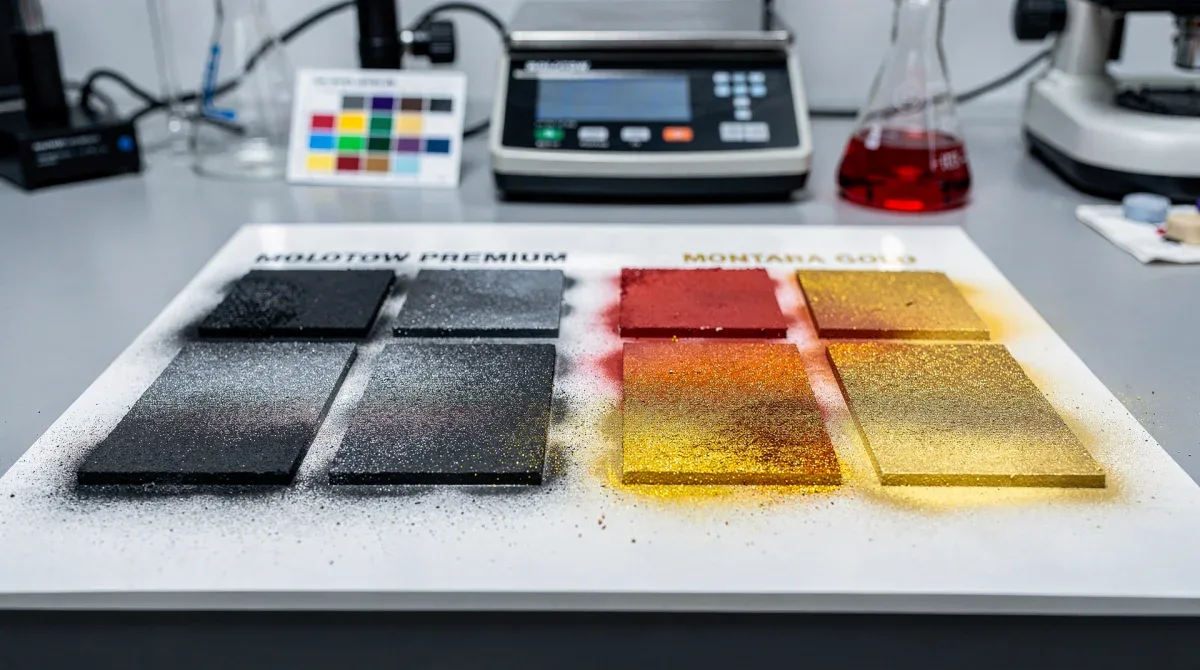
A practical cost comparison can involve recording how much paint is used to achieve an acceptable finish across identical test panels prepared for comparable applications.
This approach helps identify differences in effective material consumption while considering the number of required coatings, additional primer expenses, and potential material lost through overspray.
However, reliable cost calculations require actual test results and current retail prices rather than assuming a particular manufacturer consistently provides more economical coverage.
Technical Comparison Between Molotow Premium and Montana Gold
Both aerosol paint ranges offer artist-oriented features, including extensive color options, interchangeable nozzles, and formulations intended to support various creative applications on suitable surfaces.
The following Molotow Premium vs Montana Gold comparison summarizes officially described product characteristics while distinguishing manufacturer claims from performance results that require independent testing.
These specifications provide a practical starting point for artists evaluating different product ranges without incorrectly treating the comparison as a completed laboratory benchmarking study.
Key Performance Metric | Molotow Premium | Montana Gold |
|---|---|---|
Standard Can Capacity | 400 ml. | 400 ml. |
Paint Formulation | Updated MOLOCRYL acrylic formulation introduced in 2026. | NC-Acrylic lacquer formulation. |
Pigment Density | Manufacturer describes a highly pigmented formulation with improved opacity. | Artist-oriented paint with coverage characteristics that vary between shades. |
Valve Control | Flowmaster valve system with updated softer handling. | Low-pressure valve system designed for controlled application. |
Color Availability | Approximately 200 colors in the updated Premium range. | 215 shades listed in the official product catalog. |
Surface Finish | Semi-matte finish according to current product specifications. | Semi-matte finish for the standard product range. |
Standard Nozzle | Updated transparent and beige Premium Skinny Cap. | Montana Skinny Cap Gold/Beige. |
Alternative Caps | Interchangeable compatible caps for different application patterns. | Montana Level Caps for different spray widths. |
Outdoor Applications | Manufacturer describes resistance to UV exposure and weather conditions. | Suitable for appropriate outdoor projects, with durability varying by product and application. |
Coverage Performance | Improved coverage claimed for selected 2026 formulations. | Coverage depends on individual shades, substrate preparation, and application conditions. |
Application Versatility | Supports detailed artwork, outlines, murals, and other creative applications. | Supports controlled artwork, gradients, decorative projects, and broader applications. |
Independent 12-Color Test Results | No independently verified comparative measurements established in this article. | No independently verified comparative measurements established in this article. |
Frequently Asked Questions About Spray Paint Performance
Which brand offers better coverage for large areas?
Molotow describes significant opacity improvements in its updated 2026 Premium range. However, determining which brand provides better coverage requires testing comparable shades over identical surfaces under controlled application conditions.
Is Molotow Premium or Montana Gold better for fine details?
Both ranges offer features designed for controlled application. Molotow uses its Flowmaster valve system and updated Skinny Cap, while Montana Gold incorporates a low-pressure system compatible with specialized Level Caps.
How do their color palettes compare in variety?
Molotow's updated 2026 Premium range contains approximately 200 colors, while Montana Gold lists 215 standard color shades. Additional specialized products may expand the available creative possibilities.
Which paint is more durable for outdoor murals?
Both manufacturers provide products intended for appropriate outdoor applications. Actual durability depends on the individual formulation, surface preparation, environmental exposure, coating thickness, and maintenance conditions.
What are the price differences between Molotow Premium and Montana Gold?
Prices vary depending on the retailer, location, selected colors, and available promotions. Artists should compare current purchasing costs and effective material consumption rather than assuming one manufacturer is consistently less expensive.
What changed in Molotow Premium during 2026?
Molotow introduced an updated acrylic formulation using MOLOCRYL binder technology, alongside improvements in coverage, application handling, elasticity, valve response, and selected color characteristics.
Is Montana Gold a low-pressure spray paint?
Yes. Montana Gold officially identifies its low-pressure valve system as an important product characteristic designed to support controlled application with compatible spray nozzles.
Can Molotow Premium and Montana Gold be used together?
Potentially, provided their formulations are compatible under the intended application conditions. Artists should test layering on a separate surface and follow manufacturer recommendations concerning drying and curing before combining products.
Does higher pigment density always mean better coverage?
No. Opacity also depends on pigment characteristics, binder composition, coating thickness, surface preparation, and application technique. Pigment concentration alone cannot determine the overall coverage performance of an aerosol paint.
Which spray paint is better for beginners?
Both brands may suit beginners depending on their preferred handling characteristics, available nozzles, budget, and creative objectives. Practicing on suitable test surfaces can help develop controlled application techniques.
Can low-pressure spray paint be used safely indoors?
Low pressure does not eliminate exposure to airborne paint particles, propellants, or solvents. Appropriate ventilation, protective equipment, and compliance with product safety instructions remain necessary.
Has an independent comparison across all 12 colors been completed?
This article provides a proposed methodology for comparing twelve color categories using available manufacturer information. It does not present independently verified laboratory measurements or claim that physical benchmarking tests have already been conducted.
Conclusion: Molotow Premium vs Montana Gold
The Molotow Premium vs Montana Gold comparison highlights two established aerosol paint ranges offering distinctive formulations, valve systems, color selections, and possibilities for professional artistic applications.
Molotow's updated 2026 formulation and Montana Gold's low-pressure system provide meaningful characteristics for artists to investigate through controlled comparisons involving their preferred colors and application techniques.
By combining verified product information, responsible safety practices, and practical experimentation, the graffiti art community can make more informed material choices while developing efficient and expressive creative workflows.